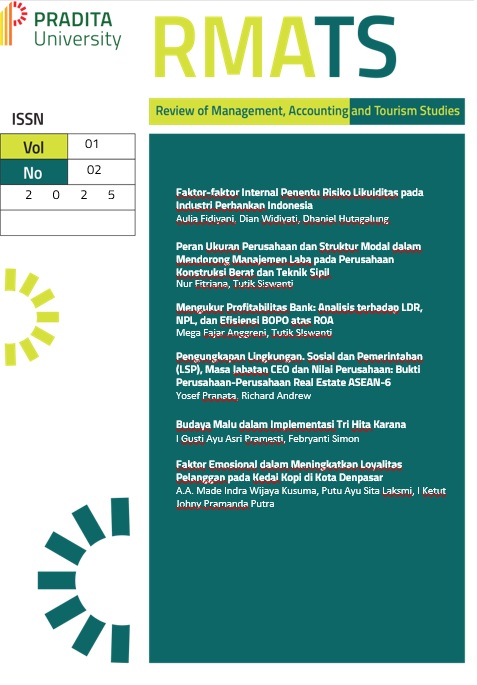
Faktor Emosional dalam Meningkatkan Loyalitas Pelanggan pada Kedai Kopi di Kota Denpasar
Emotional Factors in Increasing Customer Loyalty at Coffee Shops in Denpasar City
Keywords:
Perceived Enjoyment, Perceived Value, Kepuasan, LoyalitasAbstract
Penelitian ini bertujuan untuk mengkaji bagaimana perceived enjoyment dan perceived value mempengaruhi loyalitas pelanggan dengan kepuasan pelanggan sebagai faktor mediasi dalam konteks kedai kopi di Denpasar. Menggunakan desain penelitian kausal kuantitatif, data dikumpulkan dari 120 responden Generasi Z yang sering mengunjungi kedai kopi lokal. Survei menggunakan kuesioner terstruktur, dan data dianalisis melalui SEM-PLS. Hasil penelitian menunjukkan bahwa perceived enjoyment berpengaruh signifikan terhadap kepuasan dan loyalitas, sedangkan perceived value hanya berpengaruh terhadap kepuasan. Selain itu, kepuasan berkontribusi positif terhadap loyalitas tetapi tidak berperan sebagai mediator dalam hubungan tersebut. Temuan ini menyiratkan bahwa aspek emosional memiliki pengaruh lebih kuat dibandingkan aspek kognitif dalam membentuk loyalitas pelanggan terhadap kedai kopi di Denpasar. Studi ini berkontribusi pada kerangka SOR dengan menegaskan peran sentral faktor emosional dalam loyalitas. Hal ini penting mengingat persaingan ketat antar kedai kopi di Bali yang mengharuskan pemilik usaha untuk fokus pada aspek experiential services. Hasil penelitian ini memberikan arahan bagi kedai kopi untuk membangun loyalitas melalui pengalaman yang menyenangkan dan ikatan emosional.
References
Abbasi, G. A., Kumaravelu, J., Goh, Y. N., & Dara Singh, K. S. (2021). Understanding the intention to revisit a destination by expanding the theory of planned behavior (TPB). Spanish Journal of Marketing - ESIC, 25(2), 282–311. https://doi.org/10.1108/SJME-12-2019-0109
Al-Sulaiti, I. (2022). Mega shopping malls, technology-enabled facilities, destination image, tourists' behavior, and revisit intentions: Implications of the SOR theory. Frontiers in Environmental Science, 10(September), 1–20. https://doi.org/10.3389/fenvs.2022.965642
Al Amin, M., Muzareba, A. M., Chowdhury, I. U., & Khondkar, M. (2024). Understanding e-satisfaction, continuance intention, and e-loyalty toward mobile payment application during COVID-19: an investigation using the electronic technology continuance model. Journal of Financial Services Marketing, 29(2), 318–340. https://doi.org/10.1057/s41264-022-00197-2
Alexander, J., & Hidayat, D. (2022). The Effect of Perceived Quality, Perceived Enjoyment, and Social Influence toward Brand Loyalty of Valorant. Journal of Business, Management, and Social Studies, 2(1), 1–8. https://doi.org/10.53748/jbms.v2i1.30
Ali, W., Danni, Y., Latif, B., Kouser, R., & Baqader, S. (2021). Corporate social responsibility and customer loyalty in food chains—mediating role of customer satisfaction and corporate reputation. Sustainability (Switzerland), 13(16), 10–12. https://doi.org/10.3390/su13168681
Alzoubi, H., Alshurideh, M., Kurdi, B. Al, Akour, I., & Aziz, R. (2022). Does BLE technology contribute to improving marketing strategies, customer satisfaction, and loyalty? The role of open innovation. International Journal of Data and Network Science, 6(2), 449–460. https://doi.org/10.5267/j.ijdns.2021.12.009
Ashfaq, M., Yun, J., Yu, S., & Loureiro, S. M. C. (2020). I, Chatbot: Modeling the determinants of users’ satisfaction and continuance intention of AI-powered service agents. Telematics and Informatics, 54(April), 101473. https://doi.org/10.1016/j.tele.2020.101473
Bae, S., Jung, T. H., Moorhouse, N., Suh, M., & Kwon, O. (2020). Sustainability-12-02956.Pdf. Sustainability, Vol 12, 3.
Barber, L. B., & Münster, M. B. (2022). Aspects of openness in Hong Kong coffee shops. Interiors: Design, Architecture, Culture, 12(2–3), 284–306. https://doi.org/10.1080/20419112.2023.2166745
Bushara, M. A., Abdou, A. H., Hassan, T. H., Sobaih, A. E. E., Albohnayh, A. S. M., Alshammari, W. G., Aldoreeb, M., Elsaed, A. A., & Elsaied, M. A. (2023). Power of Social Media Marketing: How Perceived Value Mediates the Impact on Restaurant Followers’ Purchase Intention, Willingness to Pay a Premium Price, and E-WoM? Sustainability (Switzerland), 15(6), 1–22. https://doi.org/10.3390/su15065331
Chen, X., Zhao, W., Yuan, J., Qin, W., Zhang, Y., & Zhang, Y. (2022). The Relationships Between Patient Experience with Nursing Care, Patient Satisfaction and Patient Loyalty: A Structural Equation Modeling. Patient Preference and Adherence, 16(December), 3173–3183. https://doi.org/10.2147/PPA.S386294
Damberg, S., Schwaiger, M., & Ringle, C. M. (2022). What’s important for relationship management? The mediating roles of relational trust and satisfaction for loyalty of cooperative banks’ customers. Journal of Marketing Analytics, 10(1), 3–18. https://doi.org/10.1057/s41270-021-00147-2
Deng, P., Yan, W., Yu, Y., Zhang, Y., & Zhang, L. (2023). The attitude of online fans: perceived value, expectation, and identification on VAR satisfaction. Frontiers in Psychology, 14(January), 1–8. https://doi.org/10.3389/fpsyg.2023.1288998
Guo, J., Li, Y., Xu, Y., & Zeng, K. (2021). How Live Streaming Features Impact Consumers’ Purchase Intention in the Context of Cross-Border E-Commerce? A Research Based on SOR Theory. Frontiers in Psychology, 12(November 2021), 1–10. https://doi.org/10.3389/fpsyg.2021.767876
Hair, J. F., Risher, J. J., Sarstedt, M., & Ringle, C. M. (2019). When to use and how to report the results of PLS-SEM. European business review, 31(1), 2-24.
Hair. (2022). A Primer on Partial Least Squares Structural Equation Modeling (PLS-SEM) Third Edition. In Journal GEEJ. http://www.joi.isoss.net/PDFs/Vol-7-no-2-2021/03_J_ISOSS_7_2.pdf
Hasan, V., Abdulahaad, E., & Salman, E. (2025). Rethinking Baghdadi Coffee Shops and Their Sustainability Through Digital Technology. Iraqi Journal of Architecture and Planning, 24(2), 110–127. https://doi.org/10.36041/iqjap.2025.157516.1142
Junita, A., Tahura, T. L., & Reza, M. (2022). The Triggering Factors of Preferred Customer’s Loyalty in Sharia Banking. Quality - Access to Success, 23(186), 162–169. https://doi.org/10.47750/QAS/23.186.21
Juwaini, A., Chidir, G., Novitasari, D., Iskandar, J., Hutagalung, D., Pramono, T., Maulana, A., Safitri, K., Fahlevi, M., Sulistyo, A. B., & Purwanto, A. (2022). The role of customer e-trust, customer e-service quality and customer e-satisfaction on customer e-loyalty. International Journal of Data and Network Science, 6(2), 477–486. https://doi.org/10.5267/j.ijdns.2021.12.006
Kim, I., Jung, H. J., & Lee, Y. (2021). Consumers’ value and risk perceptions of circular fashion: Comparison between secondhand, upcycled, and recycled clothing. Sustainability (Switzerland), 13(3), 1–23. https://doi.org/10.3390/su13031208
Kurniawan, S., & Tankoma, A. (2023). The Effect of Perceived Ease of Use and Perceived Enjoyment on Customer Trust and Loyalty in Online Food Delivery Service. Binus Business Review, 14(2), 163–170. https://doi.org/10.21512/bbr.v14i2.8874
Kusumawati, A., & Rahayu, K. S. (2020). The effect of experience quality on customer perceived value and customer satisfaction and its impact on customer loyalty. TQM Journal, 32(6), 1525–1540. https://doi.org/10.1108/TQM-05-2019-0150
Laosuraphon, N., & Nuangjamnong, C. (2022). Factors affecting customer satisfaction, trust, and repurchase intention towards online streaming shopping in Bangkok, Thailand: A Case Study of Facebook Streaming Platform. AU-HIU 2(2), 21–32.
Miao, M., Jalees, T., Zaman, S. I., Khan, S., Hanif, N. ul A., & Javed, M. K. (2022). The influence of e-customer satisfaction, e-trust and perceived value on consumer’s repurchase intention in B2C e-commerce segment. Asia Pacific Journal of Marketing and Logistics, 34(10), 2184–2206. https://doi.org/10.1108/APJML-03-2021-0221
Mofokeng, T. E. (2021). The impact of online shopping attributes on customer satisfaction and loyalty: Moderating effects of e-commerce experience. Cogent Business and Management, 8(1). https://doi.org/10.1080/23311975.2021.1968206
Molinillo, S., Japutra, A., & Liébana-Cabanillas, F. (2020). Impact of perceived value on casual mobile game loyalty: The moderating effect of intensity of playing. Journal of Consumer Behaviour, 19(5), 493–504. https://doi.org/10.1002/cb.1831
Naradipa, C. (2020). The Effect of Perceived Ease of Use, Perceived Enjoyment, Perceived Cohesion, Social Norm and Customer Preference to Customer Loyalty Online Game Community First Person Shooter in Surabaya. KnE Social Sciences, 2020, 117–125. https://doi.org/10.18502/kss.v4i7.6847
Nguyen, N. X., Tran, K., & Nguyen, T. A. (2021). Impact of service quality on in-patients’ satisfaction, perceived value, and customer loyalty: A mixed-methods study from a developing country. Patient Preference and Adherence, 15, 2523–2538. https://doi.org/10.2147/PPA.S333586
Paulose, D., & Shakeel, A. (2022). Perceived Experience, Perceived Value and Customer Satisfaction as Antecedents to Loyalty among Hotel Guests. Journal of Quality Assurance in Hospitality and Tourism, 23(2), 447–481. https://doi.org/10.1080/1528008X.2021.1884930
Rahardja, U., Hongsuchon, T., Hariguna, T., & Ruangkanjanases, A. (2021). Understanding impact sustainable intention of s‐commerce activities: The role of customer experiences, perceived value, and mediation of relationship quality. Sustainability (Switzerland), 13(20). https://doi.org/10.3390/su132011492
Rodrigues, R. S., & Patah, L. A. (2025). Customer loyality in e-commerce: a case study on deadline compliance in Brazilian retail during the Covid-19 pandemic. ReMark - Revista Brasileira de Marketing, 24(3), e29256. https://doi.org/10.5585/2025.29256
Rouibah, K., Al-Qirim, N., Hwang, Y., & Pouri, S. G. (2021). The determinants of ewom in social commerce: The role of perceived value, perceived enjoyment, trust, risks, and satisfaction. Journal of Global Information Management, 29(3), 75–102. https://doi.org/10.4018/JGIM.2021050104
Sang, N. M. (2024). Bibliometric insights into the evolution of digital marketing trends. Innovative Marketing, 20(2), 1–14. https://doi.org/10.21511/im.20(2).2024.01
Suhartanto, D., Brien, A., Primiana, I., Wibisono, N., & Triyuni, N. N. (2020). Tourist loyalty in creative tourism: the role of experience quality, value, satisfaction, and motivation. Current Issues in Tourism, 23(7), 867–879. https://doi.org/10.1080/13683500.2019.1568400
Tran, K., Nguyen, T., Tran, Y., Nguyen, A., Luu, K., & Nguyen, Y. (2022). Eco-friendly fashion among generation Z: Mixed-methods study on price value image, customer fulfillment, and pro-environmental behavior. PLoS ONE, 17(8 August), 1–22. https://doi.org/10.1371/journal.pone.0272789
Tuncer, I., Unusan, C., & Cobanoglu, C. (2021). Service Quality, Perceived Value and Customer Satisfaction on Behavioral Intention in Restaurants: An Integrated Structural Model. Journal of Quality Assurance in Hospitality and Tourism, 22(4), 447–475. https://doi.org/10.1080/1528008X.2020.1802390
Uzir, M. U. H., Jerin, I., Al Halbusi, H., Hamid, A. B. A., & Latiff, A. S. A. (2020). Does quality stimulate customer satisfaction where perceived value mediates and the usage of social media moderates? Heliyon, 6(12). https://doi.org/10.1016/j.heliyon.2020.e05710
Valverde-Roda, J., Moral-Cuadra, S., Aguilar-Rivero, M., & Solano-Sánchez, M. Á. (2022). Perceived value, satisfaction and loyalty in a World Heritage Site Alhambra and Generalife (Granada, Spain). International Journal of Tourism Cities, 8(4), 949–964. https://doi.org/10.1108/IJTC-08-2021-0174
Wilson, N., Keni, K., Henriette, P., & Tan, P. (2024). The Role of Perceived Usefulness and Perceived Ease-of-Use Toward Satisfaction and Trust which Influence Computer Consumers’ Loyalty in China. Gadjah Mada International Journal of Business, 23(3), 262–294. http://journal.ugm.ac.id/gamaijb
Wu, Y., & Huang, H. (2023). Influence of Perceived Value on Consumers’ Continuous Purchase Intention in Live-Streaming E-Commerce—Mediated by Consumer Trust. Sustainability (Switzerland), 15(5). https://doi.org/10.3390/su15054432
Xu, H., Cheung, L. T. O., Lovett, J., Duan, X., Pei, Q., & Liang, D. (2023). Understanding the influence of user-generated content on tourist loyalty behavior in a cultural World Heritage Site. Tourism Recreation Research, 48(2), 173–187. https://doi.org/10.1080/02508281.2021.1913022
Yin, J., & Qiu, X. (2021). Ai technology and online purchase intention: Structural equation model based on perceived value. Sustainability (Switzerland), 13(10). https://doi.org/10.3390/su13105671
Zhang, J., Jiang, N., Turner, J. J., & Pahlevan-Sharif, S. (2022). The Impact of Scarcity on Consumers’ Impulse Buying Based on the S-O-R Theory. Frontiers in Psychology, 13(June), 1–9. https://doi.org/10.3389/fpsyg.2022.792419
Downloads
Published
Issue
Section
License
Copyright (c) 2025 A.A Made Indra Wijaya Kusuma, Putu Ayu Sita Laksmi, I Ketut Johny Pramanda Putra

This work is licensed under a Creative Commons Attribution-NonCommercial-ShareAlike 4.0 International License.